I would guess, fairly confidently, that everyone who pursues any kind of visual work with any seriousness hits those periods where things dry up in the studio and production drops off or stops altogether. If you’re lucky and that is not the case, I’m jealous.
For the rest of us, there are any number of reasons why this might happen. Times of transition are ripe for this kind of situation. I remember upon graduation from undergraduate school, being terrified that I would not work again. I had been very productive in college and felt good about where I was at with my work. None-the-less, once I was out of school and working, I had a hard time getting much done. I had no studio and was working in my shared apartment. I had to push myself to start new pictures. It was scary.
Over the years, there have been other times when I could not get on track in the studio. There were multiple reasons for it: other life transitions, depression, anxiety, work (which causes both). For the uninitiated, it might seem ironic that my (former) employment, teaching art, would get in the way of doing my own work, but it is it very true for dedicated teachers. Passions are divided and maintaining an active studio is a challenge. Class preparation and other faculty obligations take a lot of time and you can’t let the students down. After all, they pay an extraordinary amount of money to go to school. If you have a family, its tougher still. Squeezing in time to keep your own work moving along is difficult.
Another common factor in the development of a slump is again ironically, exhibitions. A one-person or two-person show that demands a larger body of work than a typical one or two-piece group show can interrupt the flow of one’s studio routine, especially if you do the framing and/or installation of the show yourself. Then there is the psychological aspect of a major show. It often feels like an ending or summing up. The result is a sense that when you get back to the studio, you’re starting anew. This may not actually be true, but it feels that way.
This is common enough that I have often tried to prepare myself ahead of time for a stoppage or tried to trick myself into maintain -ing working momentum. It never works. My last big show in 2024 (with my great friend Joe Morzuch) at the Dixon Gallery and Gardens is a case in point. The work I showed came from an ongoing group of pictures of a local creek that I had painted over the past year. I was still deeply involved with more of these paintings as the show started and I thought I had outsmarted myself. I kept right on working and some of the pictures I did during and after the show, I thought were better than those included. Then, about six months later, it all dried up. I had drawings for several more creek paintings completed, but I couldn’t even put color on them.
This ended a streak of years of uninterrupted work stretching back to 2017, one of the most productive periods of my life. Half of 2024 was bad, but 2025 was a total bust. I produced almost nothing. It wasn’t for lack of trying, either. I don’t take this stuff lying down. My philosophy is that you have to try to make something happen. Over the years, people have said to me, ‘Just let it go, relax, take a break’. I can’t do it. I make myself go in the garage even if I know nothing is going to happen. I sometimes sit there for a while looking around the room unable to even make a mark on a page. I know nothing is going to happen, but I’m terrified that if I don’t make an effort, I’ll never work again.
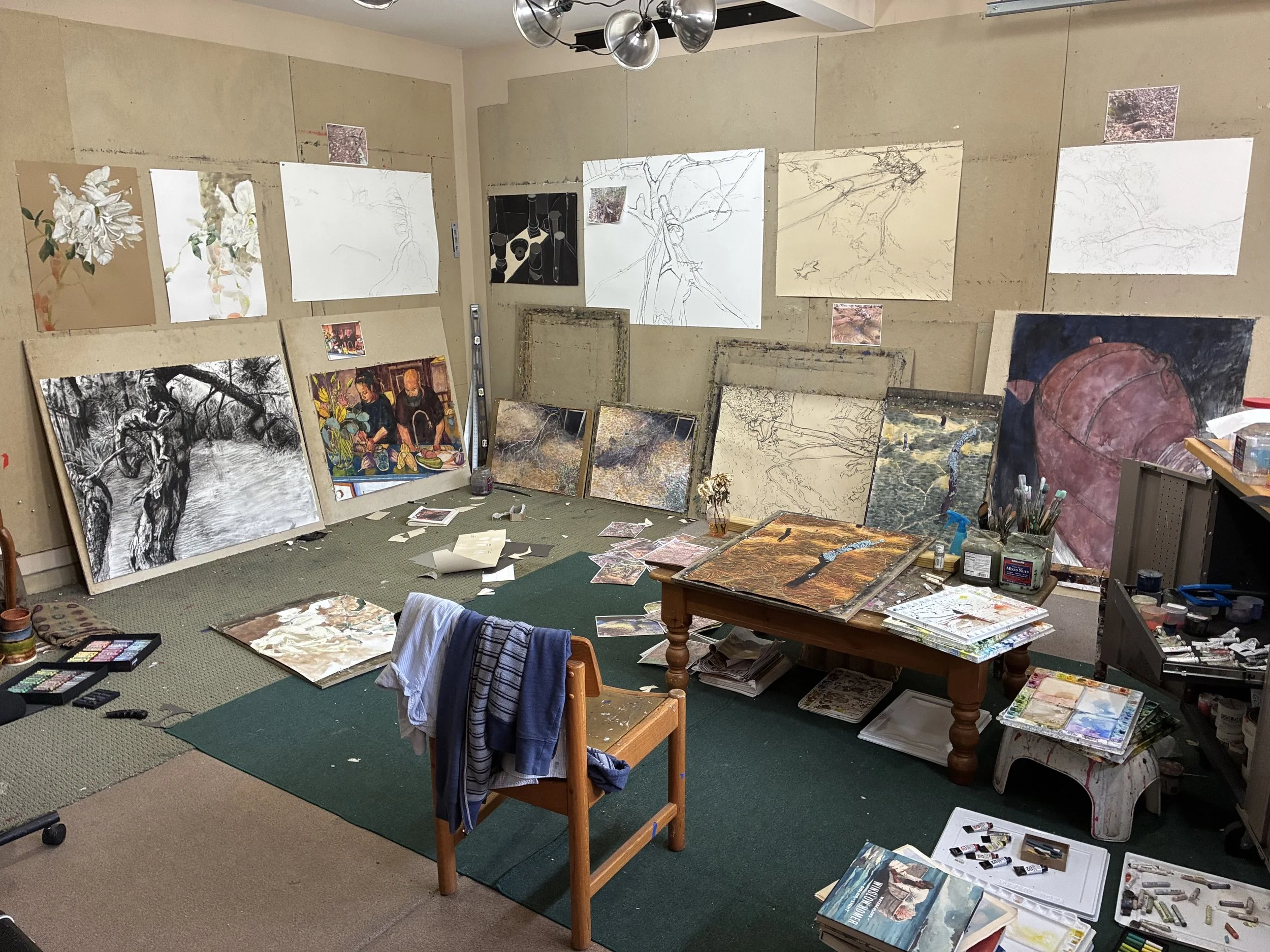
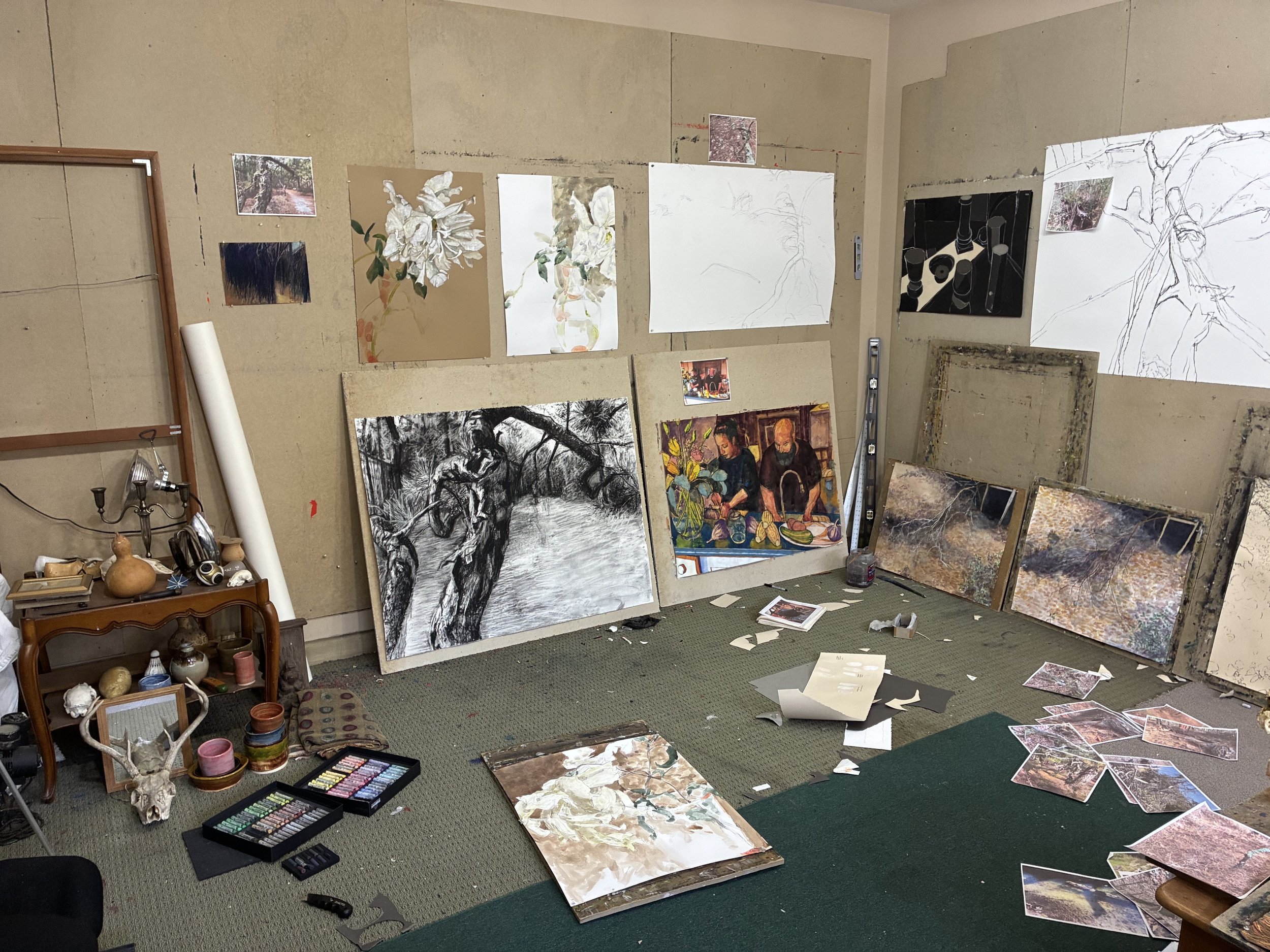
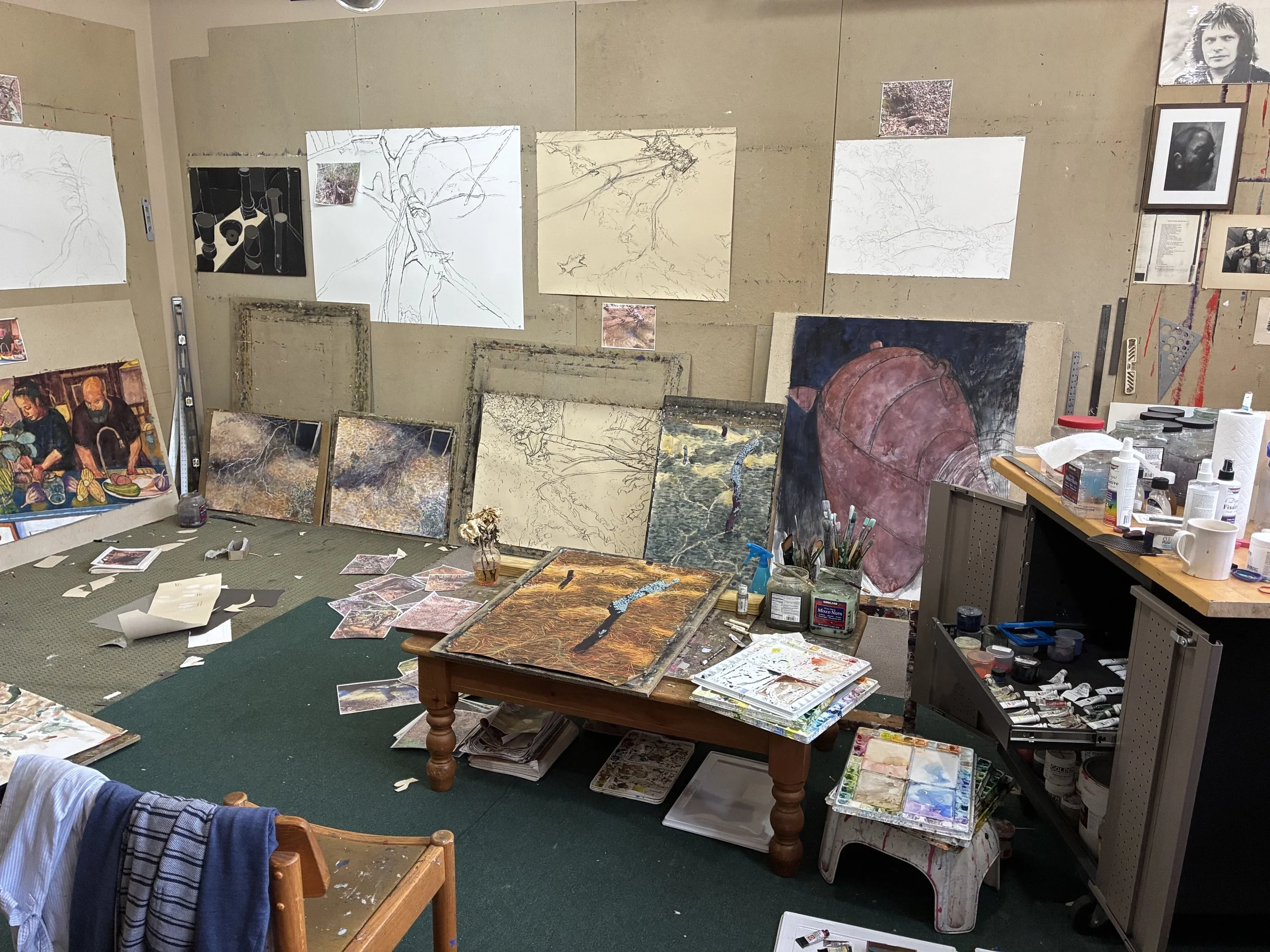
Eventually, for whatever reason, things start to happen again. I like to believe its because I’m pushing myself to get in there, but who knows? Slowly, I pick up steam and suddenly, I don’t have to try, I’m just in the garage without thinking about it. That’s what its like now: too many pieces started and tacked to the walls and laying on the floor, stuff all over the place. Just the way it should be.